What Personal Information Should Children Avoid Sharing With AI?
Introduction
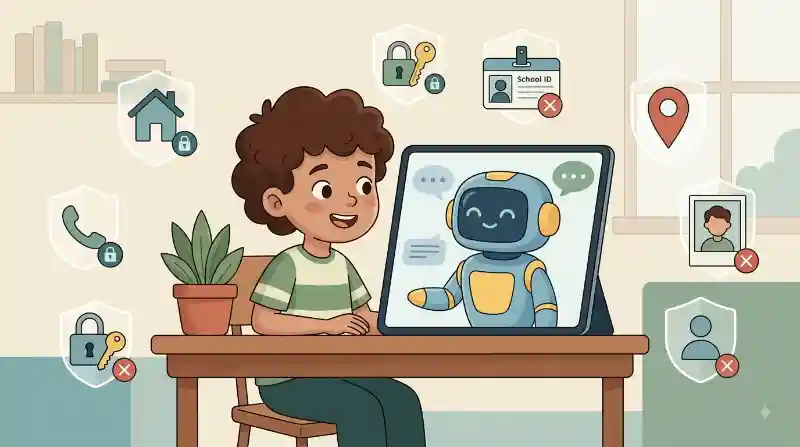
Talking to an AI chatbot can feel a little like asking a helpful person a question. But children should remember that an AI service is still an online service, not a private diary. Children can use AI without telling it everything about themselves. In fact, one of the most important AI safety habits is knowing which information should stay private. A simple rule is: if information could identify you, locate you, access your accounts, or reveal something private about you or your family, do not share it without checking with a trusted adult.
Keep Names, Addresses, and Locations Private
Children should avoid sharing information that could help someone identify or locate them. This includes:
- Full name
- Home address
- Exact live location
- Personal phone number
- Personal email address
- School name combined with identifying details
- Regular routes or schedules
For example, there is usually no need to tell an AI:
“My name is Sam, I am 11, I attend this school, and I walk home along this road at 3:30.”
If location is useful for a question, children can often be less specific. Instead of giving a home address, they might simply say:
“I live in Kathmandu.”
Never Share Passwords, PINs, or Financial Information
Some information should be treated as secret, not merely private. Children should never give an AI:
- Passwords
- PIN numbers
- One-time passwords or verification codes
- Bank account information
- Debit or credit card numbers
- Mobile banking details
- Digital wallet passwords
- Security answers
AI does not need a child’s password to explain how to reset an account or create a stronger password. The same rule applies if an AI conversation appears friendly or asks follow-up questions: secret login information stays secret.
Be Careful With Photos, Voice, IDs, and Documents
Personal information is not limited to words. Photos, videos, voice recordings, identification documents, and school records can also reveal who a child is. Children should avoid uploading things such as:
- Citizenship, passport, or birth-certificate images
- School ID cards
- Report cards containing personal details
- Medical documents
- Private photographs
- Photos showing a home address or location
- Voice recordings containing sensitive information
Even an ordinary photo can contain details in the background, such as a school badge, street sign, house number, or document on a table.
Before uploading a file, children should ask:
“Does this show anything about me that does not need to be shared?”
Family, School, and Health Information Can Also Be Private
Children sometimes understand that passwords are private but may not realize that information about other people also deserves protection.
Avoid unnecessarily sharing:
- Parents’ phone numbers or workplaces
- Family financial problems
- Private conversations
- Another person’s photograph
- A friend’s secrets
- School records
- Health or medical information
- Details about where family members are at a particular time
For example, asking AI for help writing about a family situation does not usually require real names, addresses, or exact identifying details. A child can replace them with general descriptions such as “my brother,” “my teacher,” or “a friend.” This allows AI to help without revealing as much private information.
What If a Child Has Already Shared Something?
Accidentally sharing personal information does not mean a child should hide what happened. The first step is to tell a parent, teacher, or another trusted adult.
Depending on what was shared, the adult may help the child:
- Delete the conversation or uploaded file if the service allows it.
- Change a password if login information was exposed.
- Contact a bank or service provider if financial information was involved.
- Review the account’s privacy and security settings.
- Watch for suspicious messages or account activity.
Most importantly, children should learn from the situation rather than becoming afraid to ask for help.
Conclusion
Children do not need to share their identity to get useful help from AI. Keep passwords, addresses, exact locations, IDs, financial information, private photos, health records, and sensitive family or school details out of AI conversations unless a trusted adult has confirmed that sharing is necessary and appropriate. A useful habit is simple: before typing, uploading, or sending, ask: “Does AI really need to know this?”
Related Sources
- https://consumer.ftc.gov/articles/protecting-your-childs-privacy-online (Federal Trade Commission)
- https://www.greatschools.org/gk/parenting/parenting-tips/guarding-your-childs-data-footprint/ (greatschools.org)
- https://kpmg.com/xx/en/our-insights/ai-and-technology/eight-tips-for-using-ai-safely.html (kpmg.com)
- https://www.unicef.org/nepal/reports/nepals-digital-generation (UNICEF)
Frequently Asked Questions
A first name alone may reveal little, but children usually do not need to provide their real name at all. Avoid combining a name with details such as school, address, age, phone number, or exact location.
It depends on what the document contains and the rules of the school. Before uploading it, remove unnecessary personal information such as a full name, student ID, address, teacher contact details, or other private information.
Tell a trusted adult and change the password immediately. If you used the same password elsewhere, those accounts may need new passwords too.