If AI Can Create Anything, What Happens to Human Creativity?
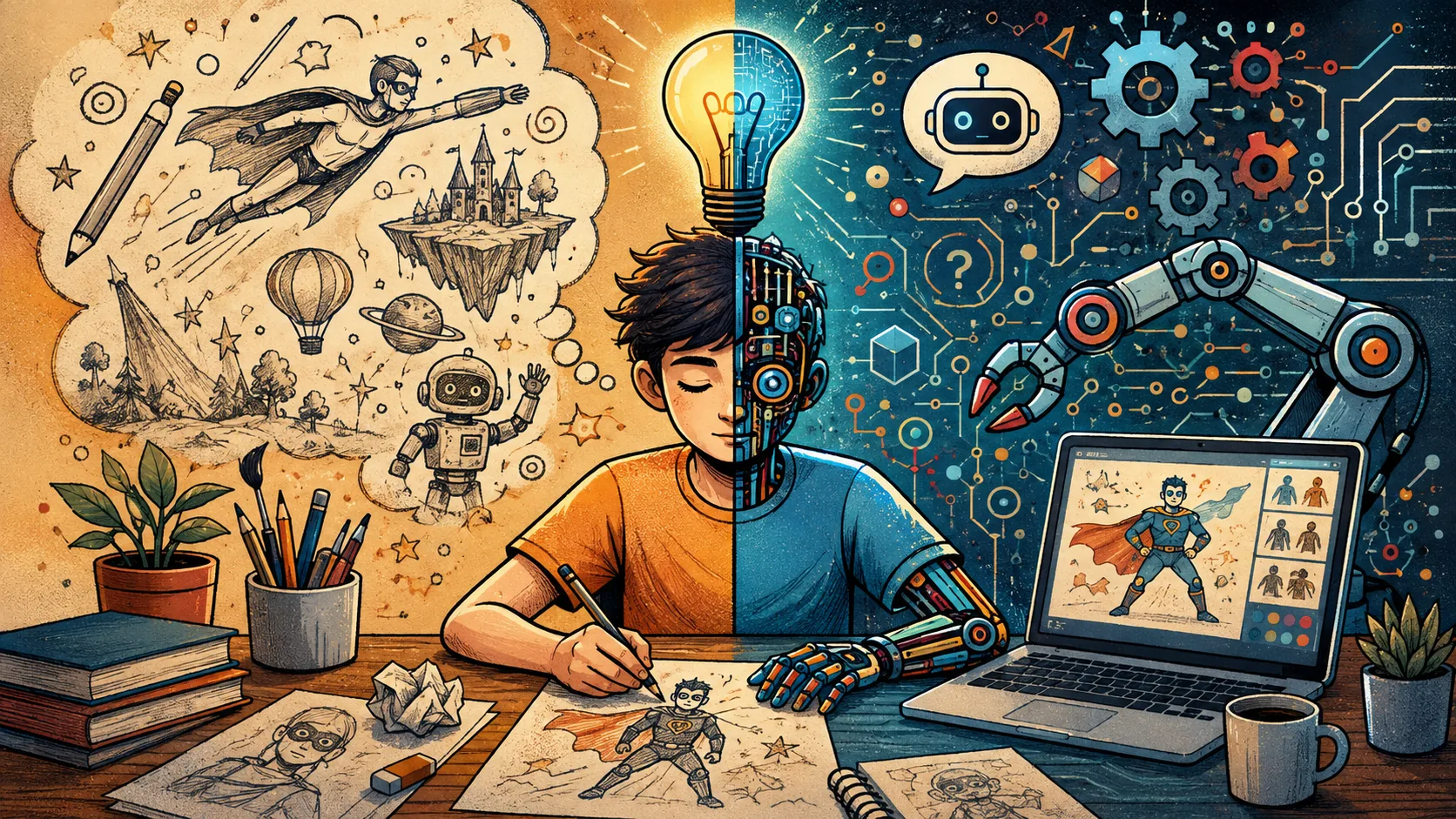
lIntroduction
AI can generate a story, design a picture, suggest a melody, or brainstorm dozens of ideas within seconds. That naturally raises a bigger question: if machines can create, what is left for human creativity? Research so far suggests the answer is not simply “AI replaces creativity” or “AI has no effect.” AI can help people produce stronger ideas, but it can also make different people’s work more similar. Human creativity is therefore not disappearing. The creative process is changing.
AI Can Generate, but Creativity Is More Than Generating
Creating something is not only about producing an image, paragraph, song, or idea. Human creativity also involves deciding:
- What is worth creating?
- What should the work communicate?
- Which idea feels meaningful?
- What should be changed or rejected?
- How does personal experience shape the final result?
AI can quickly produce possibilities, but a person still brings purpose, context, taste, values, and lived experience. Imagine a student in Nepal creating a poster about a local festival. AI might generate ten visual ideas, but understanding which symbols are culturally meaningful and what story the poster should tell requires more than simply producing an attractive image.
AI Can Help People Become More Creative
AI can be useful when someone is stuck. A writer can request different story directions. A designer can explore visual variations. A student can brainstorm project ideas. A business owner can experiment with several campaign concepts before choosing one. Research published in Science Advances found that people given generative-AI ideas produced short stories rated as more creative, especially participants who initially scored lower on creativity measures.
Other research has also found that AI assistance can improve idea generation in certain creative tasks. This suggests that AI can work well as a creative starting point. It can widen the number of possibilities a person sees before deciding where to go next.
The Risk: Everyone Starts Creating Similar Things
There is also an important downside. The same Science Advances study found that although AI helped individual writers, stories created with AI assistance became more similar to one another. Research published in Nature Human Behaviour has also reported reduced diversity in AI-assisted brainstorming.
Think about thousands of people asking similar AI systems:
“Give me a creative idea for a coffee shop logo.”
Each person may receive a useful result. But if everyone begins from similar AI suggestions, many final designs may start moving in the same direction. So AI may increase individual creative performance while reducing collective originality. That makes independent thinking more—not less—important.
The Human Role Moves From Producing to Directing
Creative work with AI increasingly involves choosing, questioning, combining, editing, and developing ideas.
Instead of asking AI:
“Create something good.”
a creator might first develop an idea, ask AI to explore several versions, reject the obvious ones, combine interesting elements, and then reshape the result personally.
Research on human–AI co-creation suggests this distinction matters. Experiments with creative writing found better results when people remained active co-creators rather than simply editing an AI-generated finished product. The strongest creative skill may therefore become knowing when to use AI—and when not to accept its first suggestion.
Keeping Human Creativity Strong
Using AI does not have to mean becoming less creative. A few habits can protect original thinking:
- Start with your own idea.
Think or sketch before asking AI for suggestions. - Ask for alternatives, not answers.
Use AI to expand possibilities rather than decide what is best. - Question predictable results.
If an idea looks obvious, explore a different direction. - Add personal experience.
Your memories, culture, emotions, observations, and perspective give creative work something generic generation cannot automatically supply. - Keep practicing without AI.
Writing, drawing, designing, composing, imagining, and problem-solving independently still develop creative ability.
Conclusion
AI does not make human creativity unnecessary. It changes the creative relationship between generating possibilities and deciding what deserves to exist. AI can provide ideas quickly. Humans still provide direction, meaning, judgment, experience, and intention. The future of creativity may therefore be less about choosing between humans and AI—and more about making sure humans remain the authors of the creative direction.
Related Sources
- https://doi.org/10.1126/sciadv.adn5290 (science.org)
- [PDF] https://doi.org/10.1038/s41562-024-01953-1 (nature.com)
- https://www.tandfonline.com/doi/full/10.1080/10400419.2024.2378264#d1e139 (tandfonline.com)
Frequently Asked Questions
Can AI actually be creative?
AI can produce outputs that people judge as novel or creative in specific tasks. However, that does not mean AI experiences imagination, emotion, or creative intention in the human sense.
Will AI replace artists and creators?
AI is already changing creative workflows, but research does not support a simple conclusion that human creativity becomes unnecessary. Human judgment, direction, originality, and collaboration remain important.
Can using AI make me less creative?
It depends on how you use it. AI can help generate ideas, but relying too heavily on its suggestions may narrow your own exploration. Using AI as a collaborator rather than an automatic answer is a stronger approach.