AI in Community Schools: Where Should a School With a Small Budget Start?
Introduction
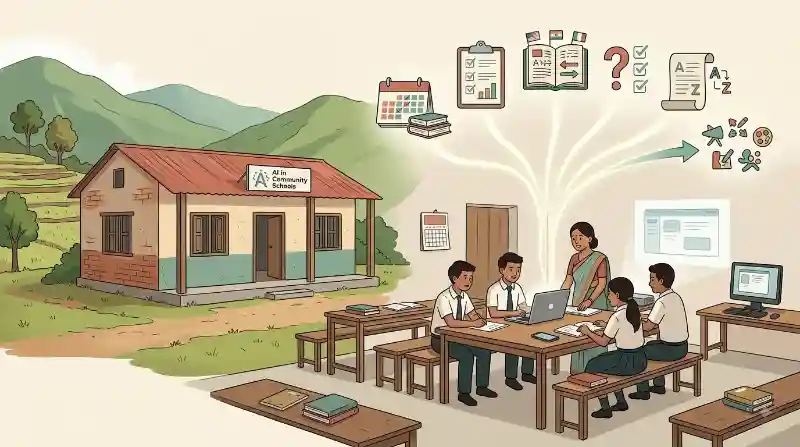
When schools hear about AI, it is easy to think they need new computers, expensive software, or a special technology lab. They do not. For a community school with a small budget, the best first step is usually much smaller, choose one useful problem, train a few teachers, use the devices already available, and test whether AI actually helps. A school should invest more only after it understands what works in its own classrooms.
Start With One School Problem, Not With Technology
Do not begin with:
“How can we bring AI into our school?”
Begin with:
“What problem are we trying to solve?”
For example, teachers may spend a lot of time creating:
- Lesson outlines
- Practice questions
- Worksheets
- Short reading activities
- Revision materials
- Parent notices
Choose one or two tasks where AI might save preparation time. For example, a Science teacher could ask an AI assistant to draft ten Grade 8 practice questions from a topic. The teacher then checks, corrects, and chooses the useful questions. That gives the school something clear to evaluate.
Train a Small Teacher Team First
A small-budget school does not need to train everyone at once. Start with perhaps two to five interested teachers from different subjects. Let them experiment with simple tasks for several weeks and share what they learn with other teachers.
The first training should cover basic skills such as:
- What AI can and cannot do
- How to write a clear instruction
- How to check AI-generated information
- How to protect student information
- When AI should not be used
Teachers should become comfortable before the school expects students to use AI independently. A teacher-first approach also makes it easier to connect AI use with real classroom needs instead of introducing technology simply because it is new.
Use the Devices the School Already Has
AI adoption does not have to begin with buying a computer for every student. Imagine a community school already has:
- One computer in the staff room
- A few teachers’ smartphones
- Internet access at certain times
- One projector
That can be enough for a first pilot. A teacher could use AI while preparing lessons and then print the final worksheet. Another teacher could prepare questions on a phone and display the reviewed material using a projector. The goal at the beginning is to learn whether AI provides enough educational value to justify further spending. Buying equipment first can create additional costs for internet access, maintenance, repairs, accounts, training, and replacement.
Choose Low-Risk Tasks That Save Teacher Time
Schools should begin with tasks where teachers remain fully in control.
Good starting activities include:
- Drafting practice questions
A teacher provides the topic and asks for a first set of questions. - Simplifying explanations
AI can suggest a simpler version of a difficult paragraph for younger learners. - Creating lesson ideas
Teachers can brainstorm examples, activities, or discussion questions. - Preparing revision materials
AI can help create flashcards, short quizzes, or review questions. - Improving communication drafts
Teachers can prepare a first draft of a school notice or parent message.
In every case, the teacher should check the final material before students see it. Avoid beginning with high-risk uses such as automatically grading students, making decisions about individual learners, or entering sensitive student records into public AI tools.
Create Simple School Rules Before Expanding
A school does not need a 30-page AI policy before beginning a small pilot. But it does need some basic rules.
For example:
- Teachers check AI-generated content before using it.
- Student names, marks, health information, phone numbers, and other sensitive information are not entered unnecessarily into AI systems.
- Students must know when AI use is allowed for assignments.
- AI supports learning; it does not replace the student’s own work.
- Important facts are checked using trusted sources.
After the pilot, teachers can meet and ask:
- Did AI save useful time?
- Which tasks worked best?
- What mistakes appeared?
- What training do teachers still need?
- Is any additional spending actually necessary?
Those answers should guide the next investment.
Conclusion
A community school with a small budget should not try to become an “AI school” overnight. Start with one problem, a few teachers, existing devices, simple tasks, and clear rules. If the pilot improves teaching or saves meaningful preparation time, the school can gradually expand training and access. The smartest first investment in AI may not be new technology at all. It may be helping teachers learn how to use the technology they already have.
Related Sources
- https://www.unesco.org/en/articles/key-nepali-stakeholders-provide-recommendations-and-directions-integrating-ai-education-nepal (UNESCO)
- https://www.worldbank.org/ext/en/topic/education/digital-technologies-in-education (World Bank)
- https://www.unesco.org/en/articles/ai-competency-framework-teachers (UNESCO)
Frequently Asked Questions
No. A school can begin with existing computers or suitable teacher devices and use AI mainly for teacher preparation before considering larger investments.
Teacher training and reliable basic access may be more useful than immediately purchasing many new devices. The school should first identify the problem it wants AI to solve and test a small pilot.
Not necessarily. Schools can begin with teachers, develop simple rules, understand the risks, and then introduce appropriate student activities gradually.