AI in Your Phone: Features You May Already Be Using
Introduction
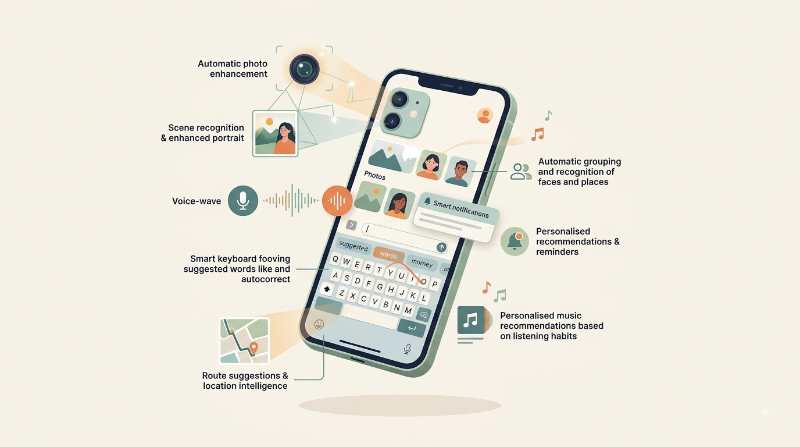
You do not need to open an AI chatbot to use artificial intelligence. If you have a smartphone, AI may already help you take better photos, type messages, understand speech, choose content, or identify unwanted messages. Many of these features have existed for years, so we often use them without thinking of them as AI. Here are some familiar examples of how AI in smartphones can quietly help during everyday tasks.
Your Camera Does More Than Take a Picture
When you press the camera button, your phone may do much more than simply capture one image.
Modern smartphone cameras can use computational techniques to combine several frames, reduce noise, balance bright and dark areas, and improve the final photograph. Some camera systems can also recognize faces, objects, or scenes to help process images.
That is why a small phone camera can sometimes produce a surprisingly clear photo in difficult lighting.
You press the button once, but the phone may perform several calculations before showing you the final picture. Research on computational photography has demonstrated how mobile cameras can combine multiple images to improve low-light and high-dynamic-range photographs.
Your Keyboard Tries to Guess What Comes Next
Have you ever typed:
“See you…”
and your phone suggested “tomorrow”?
That is another everyday use of machine learning.
Predictive keyboards look for language patterns to suggest words, complete sentences, and correct some typing mistakes. The goal is not to read your mind. The system estimates which word is likely to come next based on patterns it has learned.
So every time you tap a suggested word instead of typing it, you may already be using AI.
Your Phone Can Turn Speech Into Text
When you use voice typing, speak a command, or ask your phone to write down what you say, the device must turn sound into words. This is called speech recognition.
AI models can learn patterns in human speech and use them to estimate which words were spoken. Modern systems can even run some speech-recognition tasks directly on mobile devices rather than always sending everything to a distant computer. Research has demonstrated compact neural speech-recognition systems designed specifically for smartphones and other mobile devices.
You may notice this technology when:
- Dictating a message
- Searching by voice
- Creating captions
- Giving voice commands
- Using some accessibility features
Apps Learn What You May Want to See
AI is also common inside the apps on your phone.
A video platform may recommend another video. A music app may suggest a song. A shopping app may show products that seem relevant to you. These systems look for patterns in information such as previous activity and use those patterns to make recommendations. This does not mean the app perfectly understands what you like.
It is making a prediction.
That is an important difference: much of everyday AI is not “thinking” like a person. It is finding patterns and making useful guesses.
AI Can Also Help Filter Unwanted Content
Another less obvious use of AI is filtering. Machine-learning systems can help identify patterns associated with spam messages, suspicious content, malware, or unwanted communications.
For example, researchers continue to study machine-learning approaches that classify SMS messages as normal or spam.
These systems are useful, but they are not perfect. A real message can sometimes be marked as spam, and an unwanted message can still get through. That is why your own judgment still matters.
Some AI Works on Your Phone, and Some Works Online
Not every AI feature works in the same place. Some AI processing can happen on your device, which means the phone performs the calculation locally. Other features send information to cloud servers for more powerful processing.
Modern research increasingly focuses on making AI models small and efficient enough to run directly on smartphones and other devices. Local processing can offer advantages such as faster responses and less need to send certain data across a network, although privacy still depends on the specific application and how it is designed.
Conclusion
AI on your phone is not limited to a new chatbot or a special “AI” button. It may already be helping with your camera, keyboard, voice input, recommendations, and spam filtering. Once you begin noticing these features, AI becomes much easier to understand: often, it is simply technology finding patterns, making predictions, and helping your phone perform everyday tasks more effectively.
Related Sources
- https://www.huffpost.com/entry/phone-features-ai_l_67d89863e4b06829461002b3
- https://www.optimum.com/articles/mobile/phones-with-ai-features
- https://wellwired.ai/blog/ai-phone-features-2026
Frequently Asked Questions
Many modern smartphones and mobile apps use machine-learning techniques, but the exact features depend on the device, operating system, apps, and model.
It can be. Modern predictive keyboards can use machine-learning language models to estimate which word or phrase is likely to come next.
No. Some AI tasks can run directly on the phone, while others depend on cloud servers or an internet connection.