From Chatbots to AI Agents: What Has Changed?
Introduction
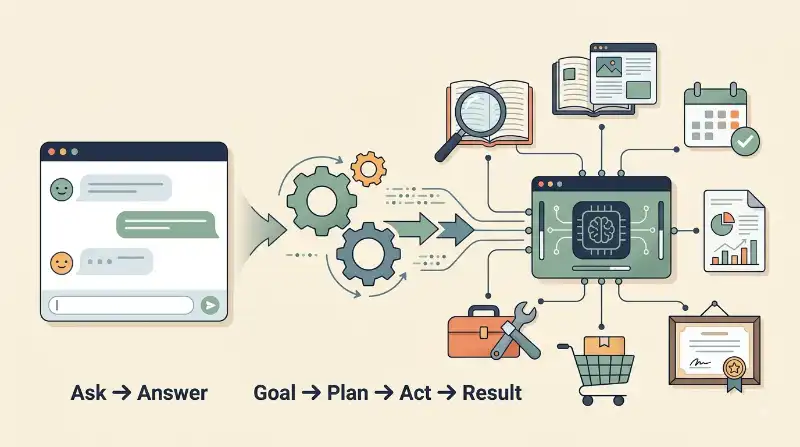
For years, most people interacted with AI by asking a question and receiving an answer. That is the basic idea behind a chatbot. AI agents add something important: action. Instead of only telling you what to do, an AI agent can be designed to work through several steps, use connected tools, check results, and continue toward a goal. So the change from chatbots to AI agents is not simply about getting better answers. It is about moving from conversation toward completing tasks.
Chatbots Mostly Respond to You
A chatbot is mainly designed for conversation. You give it a message such as:
“Help me write an email.”
The chatbot produces a draft. You read it, make changes, and decide what happens next. Modern chatbots can do much more than older rule-based systems. They may explain difficult ideas, summarize documents, generate content, answer follow-up questions, and remember parts of a conversation. But the basic pattern is still often:
You ask → AI responds → you take the next step.
You remain the person moving the task forward.
AI Agents Move From Answers to Actions
An AI agent is designed to work toward a goal, not only respond to one message. Imagine you say:
“Help me organize my meetings for next week.”
A chatbot might suggest a schedule. An AI agent with the right tools and permission could potentially do more. It might:
- Check your calendar.
- Find available time.
- Compare several options.
- Prepare a suggested schedule.
- Use another connected tool to complete an approved action.
This ability to work through several connected steps is one of the main differences between ordinary chatbots and agentic AI systems. The exact actions depend on which tools the agent can access and what permission the user gives it.
What Gives an AI Agent More Ability?
AI agents usually combine several capabilities.
- Planning:
The agent can break a larger goal into smaller tasks. - Tool use:
It may connect to software such as calendars, search systems, databases, or other applications. - Memory or context:
Some systems can keep useful information from earlier steps while working through a task. - Feedback:
The agent can sometimes examine what happened after an action and decide what to do next.
This creates a loop:
Goal → Plan → Action → Check → Next Action
That is different from a simple question-and-answer conversation. It also explains why researchers describe modern agents as systems that combine language models with planning, memory, tool use, and interaction with their environment.
A Simple Example: Planning a Trip
Imagine you want to plan a trip from Kathmandu to Pokhara. With a chatbot, you might ask:
“Help me create a two-day Pokhara itinerary.”
It could suggest places to visit, activities, and a basic schedule. An AI agent with access to suitable tools could potentially handle a larger task:
“Help me prepare my Pokhara trip.”
It might search available travel options, compare them, organize possible activities, check your calendar, and prepare a complete plan for you to review. The important difference is not that the AI suddenly “thinks like a person.” The difference is that the system can connect information, tools, and actions across several steps.
More Action Also Means More Responsibility
Giving AI the ability to act creates new risks. A chatbot giving you a bad suggestion is one problem. An agent taking the wrong action can be more serious.
For example, an agent may have access to:
- Emails
- Files
- Calendars
- Business systems
- Personal information
- Other connected applications
That means users need to pay attention to permissions.
A useful rule is:
The more an AI system can do, the more carefully we should control what it can access and which actions require human approval.
Security researchers are already studying issues such as agents following harmful instructions hidden inside websites, emails, or other information they process. AI agents are becoming more capable, but reliability, security, and human oversight still matter.
Conclusion
The move from chatbots to AI agents can be explained simply: Chatbots mainly help you think and communicate. AI agents can also help you act. Agents can plan, use tools, and work through several steps toward a goal. That makes them potentially more useful—but also gives users more reason to control permissions, review important actions, and keep humans involved in important decisions.
References
- [PDF] https://doi.org/10.1016/j.mlwa.2020.100006 (sciencedirect.com)
- https://aembit.io/blog/from-chatbots-to-agents-agentic-ai-evolution/ (aembit)
- https://www.skysync.nyc/blog/chatbot-vs-ai-agent (skysync)
- https://www.computerworld.com/article/4083589/from-chatbots-to-colleagues-how-agentic-ai-is-redefining-enterprise-automation.html (computerworld.com)
Frequently Asked Questions
Not exactly. A chatbot mainly focuses on conversation, while an AI agent can be designed to plan tasks, use external tools, and take multiple actions toward a goal.
Some agents can perform parts of a task with limited human involvement, but their level of independence varies. Important actions may still need human approval, especially when sensitive data, money, or important systems are involved.
Probably not. Simple conversation is still useful. Chatbots and agents can serve different purposes, and some systems may combine both approaches.