How AI Can Help Busy Parents Save Time Every Day
Introduction
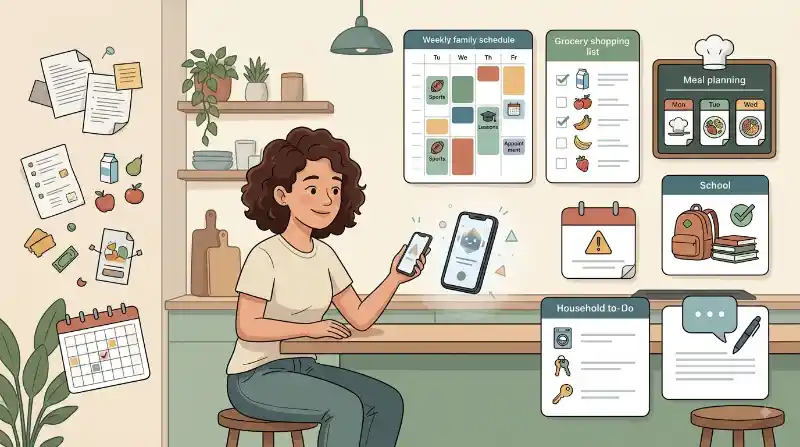
Parenting involves dozens of small decisions every day. What should we cook? When is the school event? How should I reply to this message? What should we pack for tomorrow? How can I explain this homework question? AI cannot take over parenting, but it can help with some of the routine thinking, writing, and organizing behind these tasks. Research has found that generative AI can reduce the time required for certain writing tasks, although those findings should not be assumed to apply equally to every activity. (Science)
For busy parents, the most useful approach is simple: use AI to prepare the first draft, then make the final decision yourself.
1. Plan Meals and Shopping More Quickly
Deciding what to cook every day can take more time than expected. Instead of starting from a blank page, a parent can tell an AI assistant what ingredients are available and ask for simple meal ideas.
For example:
“I have rice, lentils, potatoes, tomatoes, eggs, and spinach. Suggest four simple family meals using mostly these ingredients.”
A family in Nepal could use the same approach with ingredients already available at home rather than asking for recipes that require a completely new shopping list. AI can also help turn a meal plan into:
- A grocery checklist
- A seven-day meal schedule
- Lunchbox ideas
- A list of ingredients grouped by category
- Ideas for using leftover food
The parent should still consider allergies, nutritional needs, personal preferences, food safety, and advice from qualified health professionals when relevant. The time-saving part is not asking AI to decide what your family should eat. It is letting AI quickly create options that you can choose from.
2. Organize Family Schedules and Checklists
Parents often keep several schedules in their heads at the same time: school, work, appointments, tuition, activities, shopping, family events, and household responsibilities. AI can help turn a messy list into something more organized.
You might write:
“Tomorrow I have work until 5 p.m. My child has tuition at 6 p.m. We need groceries, a school project is due Wednesday, and I need to call the dentist. Organize this into a simple priority list.”
You can also ask AI to create reusable checklists for recurring situations.
For example:
- School-morning checklist
- Travel packing list
- Weekly household checklist
- Birthday-party preparation list
- Parent-teacher meeting checklist
- Items children need for a school trip
This is especially useful when the task itself is simple but remembering every small detail takes mental energy.Always check the list yourself. AI does not know your family circumstances unless you provide the relevant information.
3. Draft Messages and Handle Everyday Family Admin
Parents regularly need to write short messages to teachers, schools, workplaces, family members, clubs, landlords, service providers, or other organizations. The message may only take a few minutes, but deciding how to phrase it can slow you down.
For example:
“Write a polite message to my child’s teacher explaining that she will miss school tomorrow because of a family appointment and asking what classwork she should catch up on.”
AI can provide a first draft, which you can then personalize.
Research published in Science found that participants using generative AI completed a set of professional writing tasks faster on average than participants who did not use it. The experiment involved professional writing rather than parenting specifically, so it is best understood as evidence that AI can assist with some drafting tasks—not proof that it saves time in every situation. (Science)
Parents can use the same general idea for:
- Polite school messages
- Event invitations
- Short announcements
- Questions for appointments
- Lists of things to discuss during a meeting
- Rewriting a confusing message more clearly
Always read the final version before sending it. AI may misunderstand your intention or add details you never provided.
4. Support Your Child’s Learning Without Doing the Work
Homework can become time-consuming for parents, particularly when a child needs help with a topic the parent has not studied recently. AI can sometimes help explain a concept in simpler language.
For example:
“Explain the water cycle in simple language for a Grade 5 student. Give one everyday example.”
Or:
“Create five practice questions about fractions without giving the answers yet.”
This can help a parent prepare an explanation or create additional practice material. However, AI should support learning rather than complete the child’s work. UNESCO recommends a human-centred and age-appropriate approach to generative AI in education and stresses the importance of privacy and appropriate oversight. (UNESCO)
A useful family rule is:
Use AI to explain, practice, question, or brainstorm—not simply to finish homework for you.
Parents should also encourage children to check important information against textbooks, teachers, or reliable educational sources.
5. Turn Too Much Information Into Something Manageable
Parents often receive long pieces of information that contain only a few details they actually need.
These may include:
- School notices
- Event instructions
- Meeting notes
- Travel information
- Long emails
- Activity schedules
- Documents from clubs or organizations
When appropriate and when the information is not sensitive, AI can help convert text into a simpler format.
For example:
“Summarize this notice into: important date, what parents need to do, what the child needs to bring, and anything that requires payment.”
You could also ask:
“Turn this into a checklist.”
This can reduce the time spent repeatedly reading a long document just to locate the important actions. Be especially cautious with documents containing children’s names, school records, medical details, identification numbers, financial information, or other private data.
UNICEF identifies children’s data protection and privacy as a core requirement for responsible AI systems involving children. (UNICEF)
6. Save Time Without Giving AI Too Much Control
The fastest option is not always the best option.
Parents should decide which tasks are safe to delegate partly to AI and which require direct human attention.
Good tasks for AI assistance
AI is often most useful for low-risk tasks such as:
- Brainstorming
- Drafting
- Organizing
- Creating checklists
- Reformatting information
- Generating questions
- Suggesting options
Tasks that need extra caution
Be much more careful when AI advice involves:
- A child’s health
- Medication
- Mental health
- Financial decisions
- Legal matters
- Personal safety
- Sensitive family information
- Important educational decisions
For these situations, AI should not replace appropriate professional advice.
Privacy matters too. UNICEF advises parents to teach children to protect information such as their full name, address, phone number, school details, and other personal information online. (UNICEF)
The American Psychological Association also recommends that parents actively discuss AI with teenagers, encourage critical thinking about AI responses, and establish appropriate boundaries rather than assuming young people will automatically understand the risks. (APA)
A useful rule for the whole family is:
Ask AI for help with the task—not authority over the decision.
Conclusion
AI will not remove the responsibilities that come with parenting, and that should not be the goal. Its practical value is in reducing some of the repetitive work around family life: preparing first drafts, organizing schedules, creating lists, simplifying information, brainstorming meals, and supporting learning. Start with one small task that regularly takes your time. Let AI create the first version, check it carefully, and decide whether it genuinely makes your day easier.The best AI time-saver is one that leaves the parent with more time and still keeps the parent in control.
Related Resources
- https://www.unicef.org/parenting/child-care/online-privacy (UNICEF)
- https://www.apa.org/topics/artificial-intelligence-machine-learning/tips-to-keep-teens-safe.html (apa.org)
- https://www.unicef.org/innocenti/reports/policy-guidance-ai-children (unicef.org)
- https://www.usecarly.com/blog/best-ai-tools-busy-parents/ (usecarly.com)
- https://www.unesco.org/en/articles/guidance-generative-ai-education-and-research (UNESCO)
- https://doi.org/10.1126/science.adh2586
Frequently Asked Questions
It can help reduce work on some drafting, organizing, brainstorming, and information-processing tasks. The amount of time saved depends on the task, the instructions you provide, and how much checking the output requires.
Choose one small recurring task. Try using AI to create a grocery list, draft a routine message, organize your weekly tasks, or turn a long notice into a checklist.
That can happen. Treat AI-generated information as something to review rather than automatically trust, especially when the answer affects health, safety, finances, education, or another important decision.