A Parent’s Guide to Understanding AI: What Families Need to Know
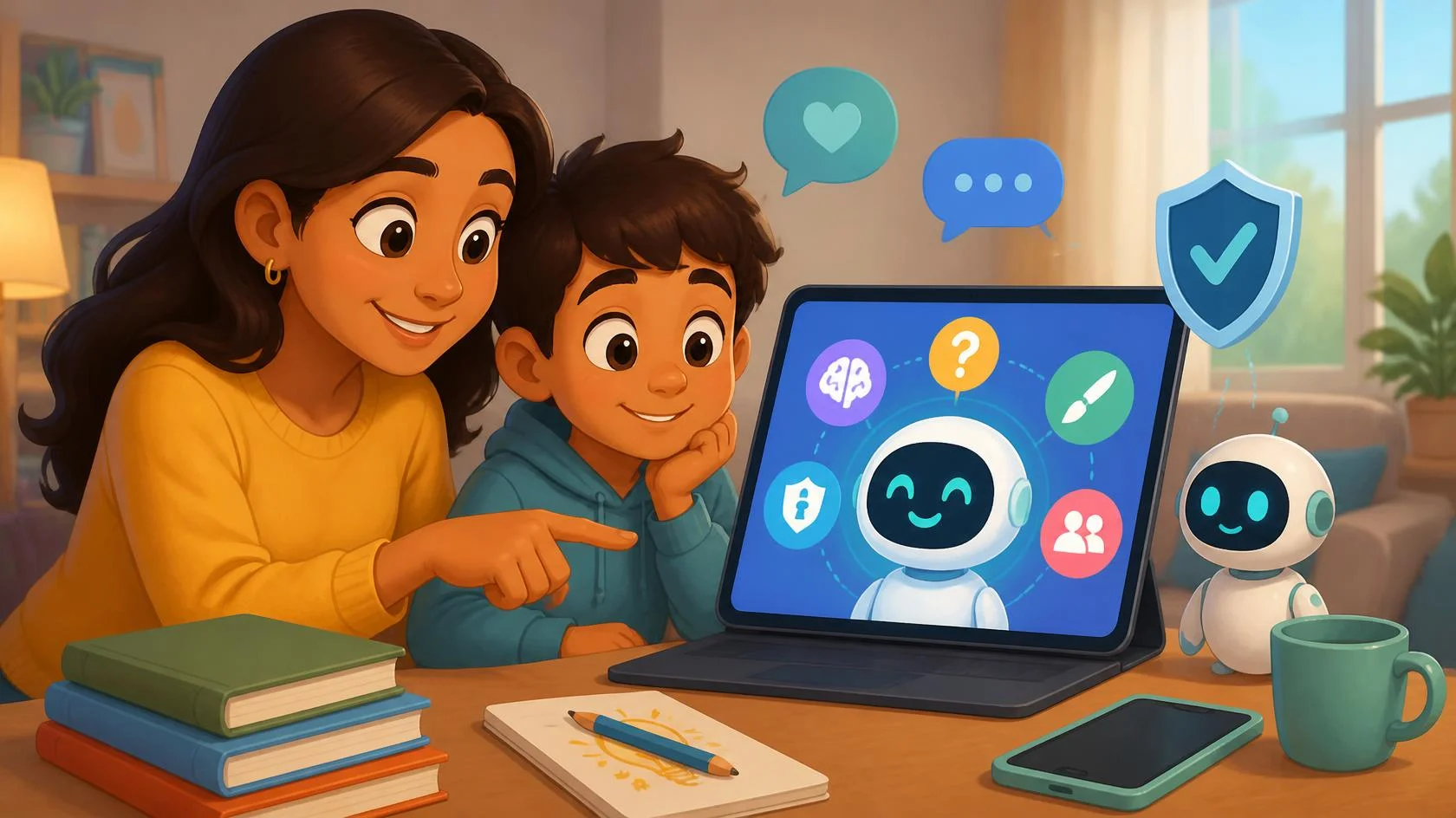
Introduction
Children are growing up with artificial intelligence around them. They may encounter AI while searching online, watching recommended videos, using learning tools, editing photos, playing games, or asking a chatbot for help with homework. For parents, this can feel like another technology to understand. You do not need to become an AI expert, but knowing the basics can help you guide your child more confidently. UNICEF’s latest guidance emphasizes that AI can create opportunities for children while also raising concerns involving safety, privacy, fairness, well-being, and children’s rights. This guide explains what parents actually need to know.
What Is AI, in Simple Words?
Artificial intelligence, or AI, is technology that allows computer systems to perform tasks such as recognizing patterns, generating content, making recommendations, or responding to questions. Different AI systems do different things.
A video platform might use AI to recommend what to watch next. A phone may use AI to improve a photograph. A generative AI tool can create text, pictures, audio, or other content from instructions given by a user.
AI does not think or understand the world exactly like a person. It works using computer models, data, instructions, and patterns. This distinction matters for children because an AI response can sound very confident even when the information is inaccurate. OpenAI’s current family AI-literacy guidance similarly advises users to double-check AI-generated information rather than assuming every answer is correct.
Where Might Your Child Encounter AI?
Children do not have to open a chatbot to interact with AI. They may encounter it through:
- Search and recommendation systems
- Educational apps
- Chatbots
- Writing and study tools
- Image and video generators
- Translation tools
- Games
- Social media
- Photo and video editing
- Voice assistants
A child in Nepal, for example, might use an AI tool to explain an English science paragraph in simpler language, brainstorm ideas for a school presentation, or translate unfamiliar words. These can be useful applications when AI supports learning rather than replacing it.
Example:
Instead of asking AI, “Do my homework for me,” a student could ask:
“Explain this maths problem step by step, but do not give me the final answer yet.”
The second approach keeps the child involved in the learning process. UNICEF notes that AI has potential to support learning and improve accessibility, including for children with disabilities, while stressing that children’s development and well-being must remain central.
The Main AI Risks Parents Should Understand
Parents do not need to panic about AI, but a few risks deserve attention.
Privacy
Children may type personal information into an AI system without realizing where that information could go.
Teach children not to casually share:
- Passwords
- Home addresses
- Phone numbers
- Private family information
- Financial information
- School records
- Personal identification documents
- Sensitive photographs
UNICEF identifies protection of children’s data and privacy as one of its core requirements for child-centred AI.
Inappropriate or Harmful Content
No automated safety system is perfect. Children may occasionally encounter content that is inaccurate, upsetting, biased, inappropriate, or unsuitable for their age.Parents should check the age requirements and safety settings of individual AI services rather than assuming every AI product is designed for children.
For example, ChatGPT currently provides linked parental controls for teen accounts that can manage selected settings, set quiet hours, reduce certain sensitive content, and control features such as image generation and voice mode. These controls do not give parents access to a teen’s private conversations.
Over-Reliance on AI
If children use AI to do all their thinking, writing, problem-solving, and homework, they may miss opportunities to develop those skills themselves. AI should often work like a helper, not a replacement.
A useful question for a child is:
“What part did the AI help with, and what part did you do yourself?”
That shifts the conversation from simply policing AI use to developing judgment.
Five Simple Family Rules for AI
Families can make responsible AI use easier by agreeing on a few clear rules.
- Protect private information.
Do not share sensitive personal or family information without asking a parent or trusted adult. - Check important answers.
AI can make mistakes, so verify school facts, health information, news, and other important claims. - Use AI to learn, not escape learning.
Ask for explanations, examples, feedback, or practice rather than simply asking AI to complete everything. - Tell an adult when something feels wrong.
If an AI response feels frightening, inappropriate, confusing, or unsafe, children should know they can stop and speak with a trusted adult. - Keep real life important.
AI should not replace sleep, exercise, hobbies, friendships, family conversations, teachers, or other real-world experiences.
Conclusion
Parents do not need to know everything about artificial intelligence before talking to their children about it. Start with the essentials: AI can be useful, AI can make mistakes, private information deserves protection, and children should remain active thinkers rather than passive users. The most valuable goal is not raising children who simply know how to operate the latest AI tool. It is raising children who know when AI is helpful, when to question it, and when to turn to a real person instead.
Related Resources
- https://www.unicef.org/innocenti/reports/policy-guidance-ai-children (unicef.org)
- [PDF] https://www.unicef.org/innocenti/media/1361/file/UNICEF-Global-Insight-AI%20guide%20for%20parents-2021.pdf
- https://www.apa.org/topics/artificial-intelligence-machine-learning/tips-to-keep-teens-safe.html (commonsensemedia.org)
- https://www.commonsensemedia.org/research/a-comprehensive-report-on-teens-tweens-and-ai (commonsensemedia.org)
- [PDF] https://doi.org/10.1016/j.caeo.2025.100318 (unicef.org)
Frequently Asked Questions
Should I stop my child from using AI?
Not necessarily. AI can support learning, creativity, and accessibility when used appropriately. The better approach is usually age-appropriate access, clear boundaries, conversation, and supervision based on the child and the tool being used.
Can children trust AI for homework?
AI can help explain concepts or generate practice material, but children should not assume its answers are always correct. Important information should be checked against trusted educational sources.
Should children share their name or school with an AI chatbot?
Children should avoid sharing unnecessary identifying or sensitive information. Parents should also review the privacy policies and settings of the specific service their child uses.